
Designing and delivering reablement programs
Endeavouring to bridge the gap between research and practice, these three publications draw on the research evidence on reablement in dementia to provide practical and evidence-informed reablement programs.
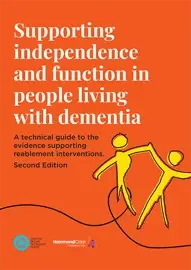
Technical Guide Second Edition
The technical guide contains the most detailed outline of the reablement interventions. It provides a detailed synthesis of the published research evidence on reablement interventions for people living with dementia.
The technical guide is targeted at:
- Health professionals designing or implementing a reablement service
- Any person who wants to read a fuller account of the research findings, learn more about a specific reablement program, or identify the original research projects and protocols from which the interventions were derived.

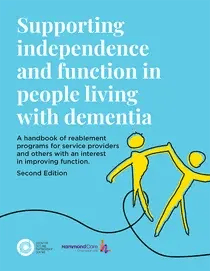
Sector Handbook Second Edition
The sector handbook presents the information detailed in the technical guide in a more accessible and summarised manner, focusing on the practical delivery of reablement programs.
The sector handbook is targeted at:
- Aged care and service providers
- Allied health and nursing professionals
- Managers
- Care workers
People living with dementia and their carers or support persons may also find the handbook useful.

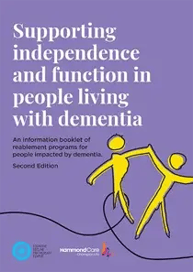
Consumer Booklet Second Edition
This booklet provides information that we hope will help people living with dementia, and those providing them support, to make more informed choices about reablement programs that could maintain or improve function and quality of life.
This booklet is written as a summary primarily for the person living with dementia but also provides an overview of key points for family members, support persons and care workers.

The technical guide contains the most detailed outline of the reablement interventions. It provides a detailed synthesis of the published research evidence on reablement interventions for people living with dementia.
The technical guide is targeted at:
- Health professionals designing or implementing a reablement service
- Any person who wants to read a fuller account of the research findings, learn more about a specific reablement program, or identify the original research projects and protocols from which the interventions were derived.
The sector handbook presents the information detailed in the technical guide in a more accessible and summarised manner, focusing on the practical delivery of reablement programs.
The sector handbook is targeted at:
- Aged care and service providers
- Allied health and nursing professionals
- Managers
- Care workers
People living with dementia and their carers or support persons may also find the handbook useful.
This booklet provides information that we hope will help people living with dementia, and those providing them support, to make more informed choices about reablement programs that could maintain or improve function and quality of life.
This booklet is written as a summary primarily for the person living with dementia but also provides an overview of key points for family members, support persons and care workers.
Evaluating reablement programs
The resources below draw on consultations with people living with dementia and family supporters, allied health professionals, and the research evidence to provide a structured approach to evaluating meaningful functional outcomes for people with dementia who participate in a reablement program.
Practitioner Guide
This assessment guide is designed to be used by allied health practitioners who are delivering reablement programs to individuals living with dementia.
The guide provides a structured approach to evaluating meaningful reablement program outcomes for the person living with dementia.
It involves three stages:
- Choosing therapy goals with clients using newly developed Reablement Goal Lists
- Defining these goals using a new dementia-specific adaptation of the SMART (Specific, Measurable, Achievable, Relevant and Time-bound) Framework
- Scoring using the Gas-Light adaptation of Goal Attainment Scaling to record and evaluate program outcomes
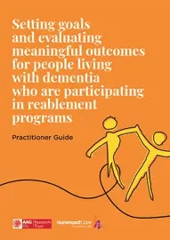

Client Workbook
This client workbook provides a summary of the practical content from the practitioner guide and is intended to be used ‘in the field’ as a workbook for allied health practitioners to use with individual clients.
If you have a client starting a new reablement program, print off a copy of this client workbook and work through it to guide goal setting by reviewing the relevant Reablement Goal Lists with your client. Once goals have been mutually agreed, practitioners can use the SMART Framework to define the goals ‘SMART’ly, and then apply GAS-Light to evaluate meaningful program outcomes.
Also included is a worksheet for your client to keep, which records their goals and reablement plan.

This assessment guide is designed to be used by allied health practitioners who are delivering reablement programs to individuals living with dementia.
The guide provides a structured approach to evaluating meaningful reablement program outcomes for the person living with dementia.
It involves three stages:
- Choosing therapy goals with clients using newly developed Reablement Goal Lists
- Defining these goals using a new dementia-specific adaptation of the SMART (Specific, Measurable, Achievable, Relevant and Time-bound) Framework
- Scoring using the Gas-Light adaptation of Goal Attainment Scaling to record and evaluate program outcomes
This client workbook provides a summary of the practical content from the practitioner guide and is intended to be used ‘in the field’ as a workbook for allied health practitioners to use with individual clients.
If you have a client starting a new reablement program, print off a copy of this client workbook and work through it to guide goal setting by reviewing the relevant Reablement Goal Lists with your client. Once goals have been mutually agreed, practitioners can use the SMART Framework to define the goals ‘SMART’ly, and then apply GAS-Light to evaluate meaningful program outcomes.
Also included is a worksheet for your client to keep, which records their goals and reablement plan.
Implementing reablement programs
This implementation guide brings together research evidence and practical tools to support organisations and service providers to prepare for and implement reablement for people living with cognitive changes or dementia in the community. It outlines a structured approach - from assessing readiness and planning implementation strategies to implementing reablement and evaluating the implementation process.
Implementation guide
Beta version
This implementation guide provides a practical, evidence-informed framework to help organisations and service providers implement and embed reablement for people living with cognitive changes or dementia in the community.
It outlines key stages including assessing organisational readiness, identifying strengths and challenges, selecting implementation strategies, implementing evidence-informed reablement, and evaluating the implementation process to support sustainability of implementation.
The guide also highlights the importance of building workforce capability, planning for reablement implementation, considering how reablement is delivered for clients living with cognitive changes or dementia and their family, and considering the broader environment in which a service is situated.

© 2026 UNSW, HammondCare and NeuRA.
This implementation guide provides a practical, evidence-informed framework to help organisations and service providers implement and embed reablement for people living with cognitive changes or dementia in the community.
It outlines key stages including assessing organisational readiness, identifying strengths and challenges, selecting implementation strategies, implementing evidence-informed reablement, and evaluating the implementation process to support sustainability of implementation.
The guide also highlights the importance of building workforce capability, planning for reablement implementation, considering how reablement is delivered for clients living with cognitive changes or dementia and their family, and considering the broader environment in which a service is situated.
© 2026 UNSW, HammondCare and NeuRA.